Showing posts with label goals. Show all posts

Monday, March 9, 2015

How to Practice: Setting Goals vs. Time

One of the most-often asked questions I get as a teacher is "how long should my child be practicing?"

This is a completely reasonable question but it's not so easy to answer. There's not a concrete answer, no black-and-white time limit each student should adhere to.

Many of my students have seen this graph in my studio:
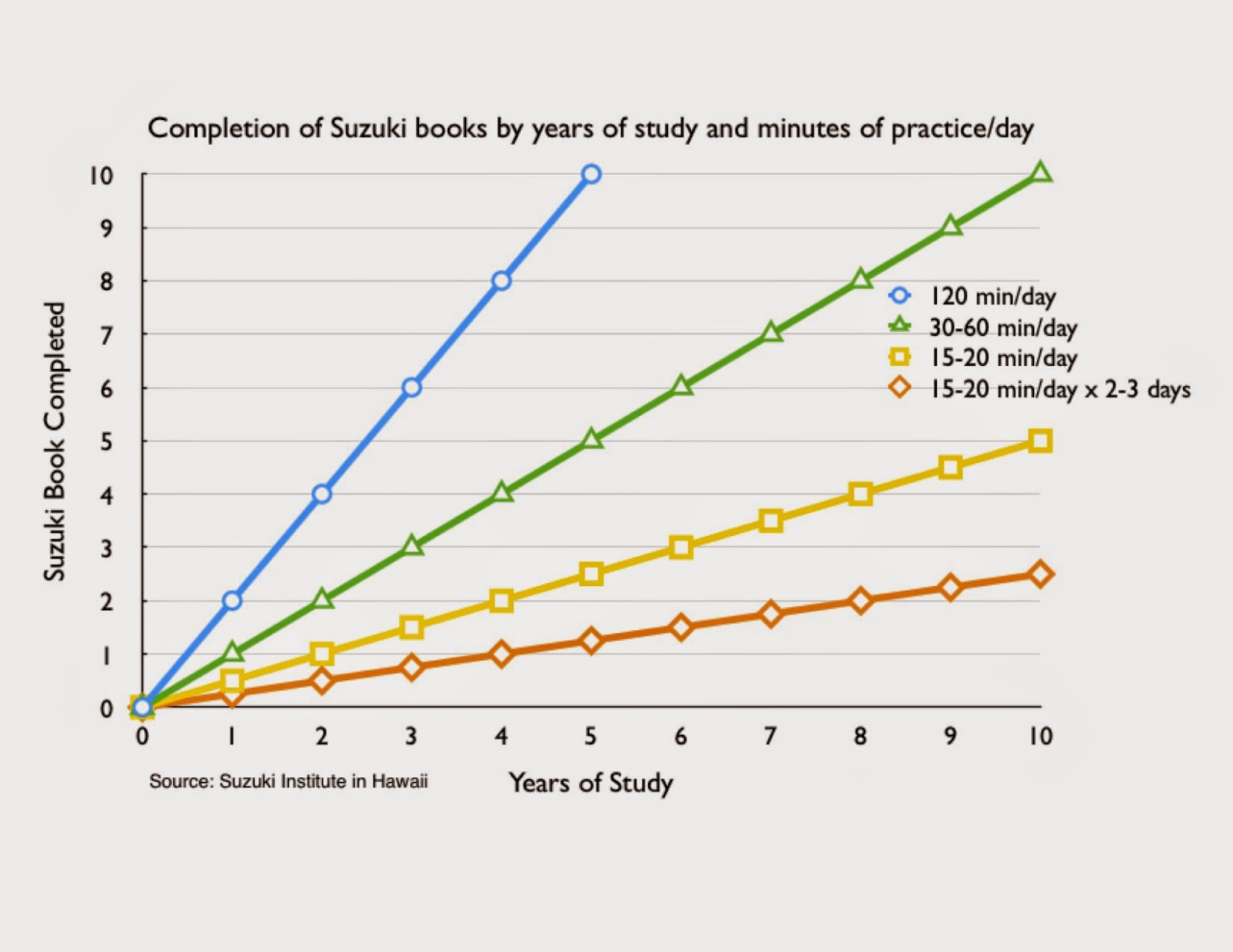

While this does give a lot of information on the effect of length of practice on progress, it doesn't quite tell the whole story. Duration and frequency of practice is important and there certainly is a relationship between practice duration, practice frequency and progress. But duration and frequency are not the only aspects that determine progress and success in learning a musical instrument. 

First off, how do you define progress? I try to de-emphasize the notion that progress is simply moving through the books and learning the next piece. First, progress looks differently for every kid. Also, progress in learning a musical instrument involves much outside of learning the next piece in the book. Progress for me means a number of different things. Progress means:
  • deeply, very deeply, learning skills
  • the ability to transfer current knowledge and skills to new domains
  • learning how to figure things out on your own with limited outside help
  • one day not needing me as a teacher (yes, I am essentially trying to put myself out of a job)

Progress is an overall increase in the educational well-being of the student and helping develop the student into a well-rounded musician and human being. 

Progress does not only mean learning the next piece and then the one after that. 

Looking closely at the graph, it indicates that a student who practices two hours a day will learn 2 books a year. In my experience, Book 1 takes the longest for most students to finish. It's the foundation book and I like for students to take 2 years to complete Book 1. That way all those foundation skills and techniques are rock solid and building on those skills won't result in a total collapse or frustration. To list them all would take quite a while, but they include: 
  • focus
  • singing
  • hearing pitch
  • holding the cello properly
  • holding the bow
  • using the bow correctly on the cello
  • playing with a good tone
  • playing in tune
  • adjusting when out of tune
  • playing on all four strings
  • playing with different finger patterns
  • staccato, legato, marcato, 
  • preliminary shifting exercises
  • fingerboard geography
  • note reading
  • tuning the instrument
  • playing with others, etc.
WHEW. That's a lot of skills. And that doesn't even come close to covering them all. Book 1 takes time. Yes, it's tedious and Twinkle is borderline painful because it takes a long time but your child will greatly benefit from fastidious development of knowledge and skills. It's hard to see it in the moment but just know there is light at the end of the Twinkle tunnel. 

As for learning two books a year with 2 hours of practice, sure, it's possible. But there are lots of other things that students need to learn outside of the Suzuki repertoire that will take time away from strictly getting through the books. For example, there are several pieces and technique books outside of the Suzuki repertoire I incorporate in my curriculum to develop well-rounded and artistic musicians. 

The Suzuki books are great but solely focusing on achieving completion of those books is akin to trying to become a well-rounded chef by only cooking through one series or one style of cookbooks. There is more knowledge that needs to be learned from other sources. Yes, this takes more time but it's worth it for the development of well-rounded musicians and accomplished learners. 

Also, many students start between the ages of 3-6. Can you really get a 3 year-old to practice for 2 hours? Nope. How about a 6 year-old? Probably not. Not only is it hard to get a little one to focus and pay attention for long periods of time, they simply do not have the physical endurance to withstand long practice sessions. It ain't gonna happen. That isn't to say a highly dedicated 7 year-old can't devote 2 hours daily to practice but I think that delves into other issues I'd rather not get into here. I believe kids should be kids. Enough said. 

***

If practice isn't determined by a set time limit, than what should it be determined by?

Goals. More specifically, the setting and achievement of specific goals within a given practice session. This may take more time at first but practicing without setting a goal is a lot like getting into your car without a destination in mind. You end up driving around in circles for a long time before (maybe) arriving where you want to be. And you waste a lot of time. I'm not about wasting time. 

Practice, lessons and rehearsals are made up of many, many aspects. But what we need to do as teachers and parents is help break everything down into the smallest unit of learning, identify accomplishable goals and set up students to accomplish those goals.  

Set achievable goal and accomplish that goal. Don't mindlessly play through everything without a goal in mind for each piece. Even if the goal is to review, make the goal 'review with a good bow hold' or 'play review pieces with the best sound possible'. And remind your child about the goal or point before they play each piece. This will bring a very different focus to the practice and also results in less frequent messy repetitions of the pieces. Every messy or sloppy performance is a reinforcement of that skill. Please avoid this! We don't want to reinforce poor cello playing!

Here's a few examples of clearly defined practice goals:
  • Practice the preview spot in Song of the Wind 10 plucked times or until it looks easy for the fingers, with clear, ringy notes every time.
  • Practice the shift in Minuet No. 2 12 times with a moving thumb and in-tune G#. 
  • Practice the 3rd section of Perpetual Motion until it feels easy and effortless before playing the whole song. Then add it to the rest of the song. 
  • Practice the bowing in line 1 of Minuet in C 6 times, in a row. If there is a mistake in one, add an additional repetition, making it 7, etc. 
  • Play Mississippi Stop Stop Twinkle for good, clean 'stops' on every Mississippi Stop Stop. 
  • Practice X piece until it feels easy, not until it's correct. 
My goal for every practice is to make any given skill easy rather than getting it right. Getting it right once does not mean the skill is learned. However, practicing something for ease automatically ensures it will be correct and repeatedly correct because it's effortless to execute.  

If you achieve your predetermined practice goals in 12 minutes rather than the 30 minute you budgeted for practice, fantastic! Go read a book for the remaining 18 minutes. Or practice more! Set another goal and achieve it! You and your child will find this practice much more motivating than playing through everything. The goal was determined and was met - that's a pretty exciting thing! And it makes students want to come back for more because it's such a positive and rewarding experience, much more so than just playing through Allegretto mindlessly thinking about what's for dinner. 

***

Next time you pull out the cello to practice with your child, work with your child to determine accomplishable goals at the start of practice or before you start something new during the practice. 

Start small. Start with something achievable in a short amount of time - think 90 seconds to 4 minutes maximum. Yup, that short. Don't bite off more than you both can chew. Setting the goal to learn all of Etude when you only have the first 4 notes is setting yourselves both up for failure and disappointment. 

Celebrate! Praise your child (and yourself!) on achieving the pre-determined goals. 

Happy (goal directed) practicing!

Monday, January 12, 2015

Thoughts on Practicing

As we settle into the new year, I have some thoughts and strategies on practice. After the break, I know everyone, including myself, needs some motivation to get back into a regular routine. I'll be returning to a lot of these topics later in and exploring them in more depth but here's a start.

I've noticed a theme lately in my teaching and my thinking - I'm stressing practice, practice techniques and strategies more in the lessons. At the start of November, I feel like we've all settled into a practicing groove and now may be a good time to address ways to make practicing easier, more efficient and more productive.

"Only practice on the days that you eat" - Shinichi Suzuki

Your child will feel the difference in their playing and you will notice a difference in their ability with daily practice. I even notice this in myself - in my 100 Days of Practice last year, I noticed a HUGE change in my ability and overall ease of playing. And it just felt good. Daily practice also helps improve memory and the ability to learn new things at a quicker pace. 

Practicing regularly also leads to motivation to practice even more. Again, as I got into the practicing 'groove' during my 100 Days, I was increasingly motivated to keep going. I even kept going after I achieved my 100 Days. If you are feeling unmotivated, the best cure is to just start somewhere and practice, even if just for a little bit. Also, stick to a regular practice time and do it every day for two weeks - this will end so many of the arguments and establish the habit of daily practice.

Routine - find one that works

This may take some time but find a routine that works. Every student/parent duo is different and try different times of the day - in the morning, before dinner, right after school, etc. I've had students have a lot of success practicing in the morning before school but others were more successful with a practice that take place later in the evening just before bath-time and bed. Everyone is a little different so take some time to experiment with your practice schedule. Also, no need to limit it to one long practice a day. I know a number of students who practice for 10-15 minutes a couple of times a day. 

Practice to make it easier, rather than perfect
This requires many, many correct repetitions. In other words, don't play it wrong 7 times and then right just once. It's just been practiced and learned wrong! One correct repetition does not wipe out 7 incorrect ones. 

Practice slowly for accuracy and skill building

Playing a new thing fast usually just results in messing up over and over again. Which leads to the above problem. Instead, practice slowly and never make a mistake. This helps ensure the skill is learned correctly the first time. Also, though this seems tedious, it's far less tedious than trying to relearn a skill that was learned incorrectly the first time. 

Have a goal determined from the beginning

I always have a goal in mind for the lessons though I don't always explicitly say it. Practice should be structured this way, too. And write it down! At first, writing down your child's (and your) goals for the practice will greatly help focus the practice. It also shows you and your child exactly what needs to be accomplished - there is no guessing, arguing, stalling or having to make a decision - and then you can check each item off the list. But involve your child in the planning process - let them make choices over what to do first or next. Over time, this super structured practice plan can diminish but for many, many years I wrote down my practice plan daily in a notebook to help structure my practice. At any level, having a game plan will also help make good use of your time. It will make the practice more efficient, especially when you can recycle the same plan with subtle changes. Also determine upfront how much time to spend on one task - and then use a timer! This gives both you and your child a clear idea of where the endpoint is. There is light at the end of the practice tunnel! 

Strategies
Break it down: don't always start at the beginning - isolate the problem and tackle it first. Starting at the beginning often just wastes time. Start with the 'meat' of the practice first. Take a small section, even a few notes, and repeat it many times, like, a zillion times.

Rhythms: use rhythms to deeply learn a challenging passage (older students know about this). Even using the Twinkle rhythms to work on tricky notes helps correctly learn a skill.

Muddle through it: “Learning is most significant when students discover for themselves rather than simply being told what to do” -Cornelia Watkins. Allow your child to struggle a little bit. I know it's hard to watch without intervening but we learn much more deeply when we have to discover things on our own. This also leads to more independent learners.

Review! Don't forget about review pieces. The skills in the Suzuki repertoire are scaffolded so everything that was previously learned is built on later, upgraded and made more challenging. When reviewing an old piece, ask your child to think about something specific so it is not mindless repetition of an old song. For example, if your child is working on fixing some bow hold issues, have them play Twinkle and really focus on the bow. The left hand will practically play itself and the additional focus on the bow with reinforce bow hold maintenance.

Listening is magic: Without it, learning a new piece is like recognizing a color you've never seen.  Dr. Suzuki recommended 5 hours of listening each day.  Car, living room, kitchen, bedroom - listening is the parent's responsibility and is also for their benefit. I recommend at least listening twice as long as you practice.

Monday, December 29, 2014

Setting Goals for 2015

With 2015 upon us, that also means New Years resolutions are in the making. And for 2015, perhaps you've made some goals for yourself and your child in regards to cello and practice. I try to set a cello goal for myself every year and I'll keep you posted on what I decide to accomplish in 2015. Last year I took on 100 straight days of practice. I started in late January and made it by May! Then I was hooked and kept going even though I wasn't keeping track anymore.

Below are just a few suggestions to making your practice goals and resolutions stick.

1. Don't bite off more than you can chew. I'm all about being ambitious, but take a step back and evaluate if your goal is really attainable. Finishing two books in one year, probably not realistic. Finishing Suzuki Book 1, definitely more realistic. Practicing every day for 2015, also probably unrealistic. Practicing every day for one month, way more attainable.

2. Start now. The new year is a great time to start off with a 'clean slate'. Don't wait. If you missed the first of the year, start on a Monday.

3. Make a plan. Then write it down. And then post it on your refrigerator or someplace you will see it often. And commit to it. For real. Good intentions are great, but unless you plan for it and commit it to paper, procrastination is more likely to strike. Making a plan will help you stick to your goals. Set a date, too!

4. Reward yourself. Include a reward to give yourself and your child at the end! But determine what the reward is during your planning stage. I honestly can't remember what I did for myself when I made it to the end of my 100 days of practice - in the end, the feeling of accomplishing my goal was a way bigger reward than my actual physical reward - but I did have a motivator there for me at the end of the tunnel.

5. Share your goal. Share your goal with friends and family members and ask them to encourage you along the way. I had my students check up on me to make sure I practiced daily and that definitely kept me going. They encouraged me to keep it up even when I was feeling discouraged or unmotivated. Those moments of decline in motivation will definitely come, especially when the honeymoon period of achieving your goal has waned. Having others supporting you will help you push through those down times and help you make your way back up.

6. Break it up. Take your big goal, which say it is finishing Suzuki Book 2, and break it up into smaller pieces, learning one piece per month. There are twelve pieces in Book 2 so it works out perfectly. Breaking your goal into smaller goals is both easier and more gratifying. Instead of trying to accomplish this huge hurdle, you celebrate the small (monthly) successes while simultaneously achieving your big goal.


I have a number of professional/cello goals I have in mind for 2015 but I think my big one will be to finish my Suzuki teacher training. I am currently not registered for Suzuki Books 9 and 10 and would like to finish my training this summer in Chicago. The problem: I never learned Suzuki Book 10. In high school and in college, I always disliked this particular piece, the Concerto in B-flat by Boccherini, so I never learned it. In order to complete my training, I need to learn it. 2015 is the year and expect to hear about my plan and my progress! 

Monday, December 15, 2014

Giving Feedback During Home Practice - Ways to Make Practice Easier and More Efficient

I'm on a 'practice' kick right now and have been thinking deeply about practice, how to make it easier, how to make it more efficient and how to make it more effective. In my reading and research, I found the information below that I've adapted from a wonderful former colleague of mine, Elisabeth Graham, that I wanted to share with you.

In the practice and lesson context, feedback is whatever happens as an immediate result of a behavior and can be positive or negative. Feedback is most effective when the connection between the behavior and the feedback are obvious and close together. Don't wait to give feedback, whether it be positive or negative. And even no feedback (verbal or nonverbal) is a form of feedback! 

The two main purposes of feedback are: information and motivation. Feedback gives meaningful information about the quality of the student's work as well as influences behavior by getting the child to either do something or stop doing something. 

Positive Feedback
What is it: When you compliment your child and tell them that they’ve done something well

Purpose: Build confidence, lighten the mood, gain repetitions of something well done, highlight progress or development; variety - mix up the verbal expressions, non-verbal ways: facial expressions, hug, high five; vary the intensity to match the victory 

Keep in Mind: Be honest but don’t go overboard; celebrate the small victories, but don't compliment everything, it loses its meaning and the behavior isn't reinforced. 

Negative Feedback
What is it: Anything you tell your child they did incorrectly or need to improve next time

Purpose: Make the child aware of what they need to fix or improve

Keep in Mind: don't make it a big deal, but give it directly and don’t be afraid of it; deliver it in a non-personal way, examples: "What I heard was…", "That time wasn’t as good…", "That wasn’t it but you are SO close we’re not going to give up!"; encourage the child to give themselves the feedback by asking leading questions or giving a listening task

Questions
Purpose: Check understanding and knowledge, encourage critical thinking and listening; 

Keep in Mind: Avoid yes/no and rhetorical questions in favor of leading and open-ended questions, don’t be afraid to let your child struggle to find the answer; give plenty of time to think, way more than you think they need; Wh- and How questions, avoid yes/no and rhetorical questions 
How do you know? To check comprehension and figure out what the student really knows 
Set them up before they play, tell them what you are going to ask at the end of the trial
("I’m going to ask you if you heard any extra sounds while you played"; "Be listening for a space between the stops in Mississippi Stop Stop")

Directives 
What: Whenever you tell your child to do something; "Play again and listen for extra strings." "After you play, tell me what you heard." "Play three times and tell me which was the best and why."

Purpose: Keep the practice moving and focused 

Keep in mind: Keep all your directives very specific and simple, take excellent notes in your lessons so you know what directives to give, come to practice prepared with what you want to do and say; break it down into the smallest elements – what are the components of very best bow hold? 

Lastly, TAKE EXCELLENT NOTES to be able to tell your child exactly what to do, you have to know exactly what to do.